Trivial Pursuit? - Jobs In The Age Of AI
Much has been said about AI displacing jobs, much continues to be said. Given the magnitude of the discussion, proper framing is warranted.
Technology is a tool, sometimes borne of necessity but mostly of the human capacity to imagine, which puts more within human reach and has the power to uplift or tear down, to build or destroy. AI is a multimodal tool with reasoning abilities and unprecedented accessibility. It's available everywhere and mostly subsidized to increase engagement. Meanwhile, a job is the regular work that a person does to earn money.
A quick glance at history verifies that technology displaces jobs but creates many more as it runs its arc. It spawns entire new industries which branch out into others.
A machine can work cheaper, better, faster and longer than a human can, about this there should be no debate, but this does not mean we teleport to Universal Basic Income because everyone will be out of work.
What is Work?
Let's try to answer the question: Why do we work?
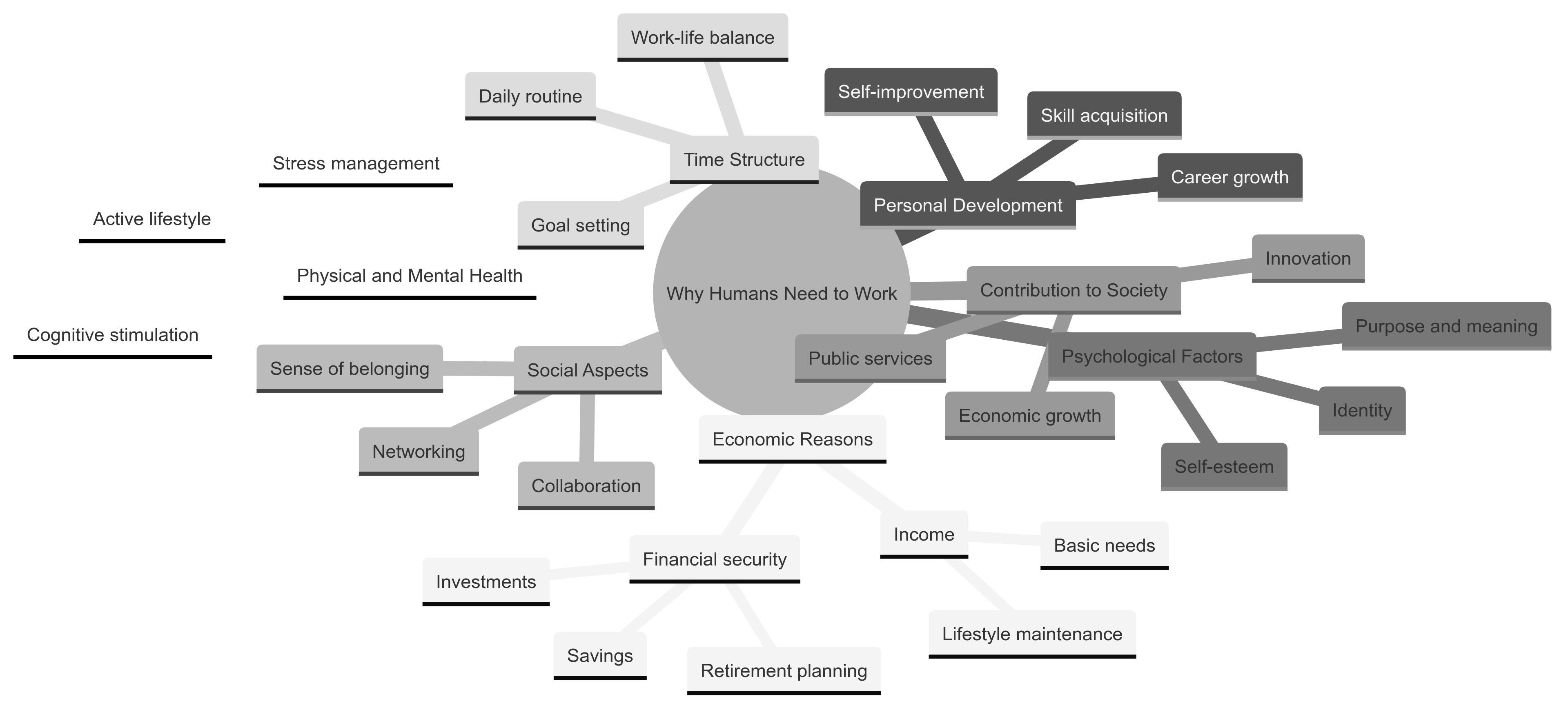
This diagram attempts to answer the Why. The reasons are many, and while some matter more than others, we do it to make ends meet, secure our future, be a part of something and many others loosely related to Maslow's hierarchy of needs.
What about the flip side? Why do companies hire people (Jobs)? They do it to fulfil a specific set of requirements (purpose), and are incentivized to maximize profits. i.e for the lowest cost.
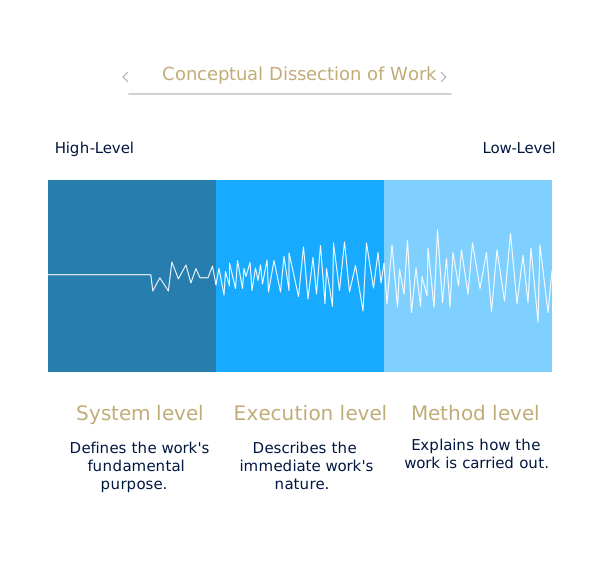
So jobs are created to fulfil a purpose, and this is usually accomplished by humans executing specific tasks. Viewed through the lens of systems, these reasons combined represent the System Level (purpose) which extends to the Execution Level (Job) and the Method Level(Tasks). These map to the Why, the What and the How.
Does Work Stop?
From post dotcom billionaires interviews to pre-iPhone studies, there is plenty to substantiate the claim that people work, and continue to work long hours, when they don't need to.
Why High Earners Work Longer Hours
Research reveals a dramatic reversal in work patterns: by 2002, the highest-paid 20% of workers were twice as likely to work long hours as the lowest-paid 20%, driven by increased "marginal incentives" for extra hours worked beyond the standard 40-hour week.
Now, as a current-day thought experiment, imagine everyone is economically secure, socially content, adequately credentialed and has an abundance of time. Let's even add Universal Basic Income in the mix.
Do humans stop working? Do writers, actors, engineers, bakers, photographers, thinkers, entertainers all call it quits? No, the very notion is absurd.
We work because we possess creative energy which requires expression, and curiosity that demands action; the power to imagine and the desire to pursue that vision’s fulfillment.
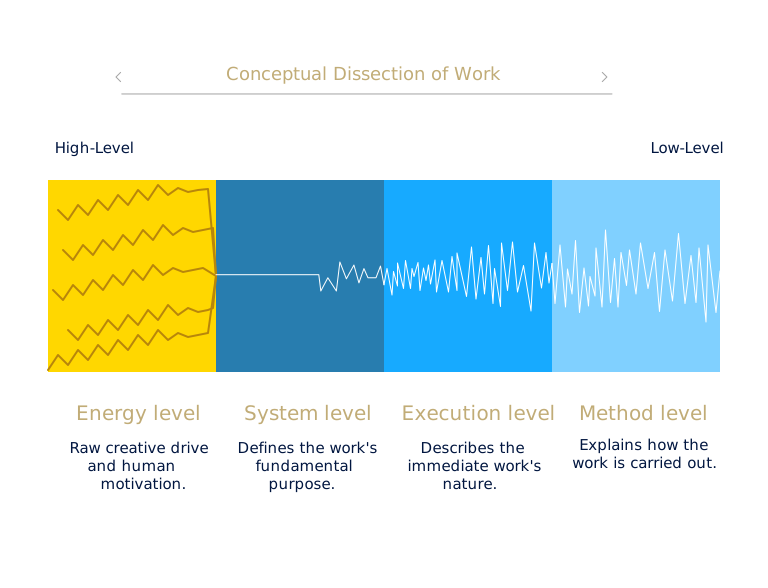
Creative Energy is the fundamental substrate other levels serve to channel and direct. Systems are energy-organizing structures which channel energy as a conduit to create value. Across industries, premiums are commanded by the most creative - those who have a way - whether they are lawyers, chefs, consultants, doctors, tennis players, musicians or anything else. The demand is endless, and the domain - creativity - is uniquely human.
Creative problem-solving and strategy - a skill that requires creativity and context - are not the direct domains of AI which can only mimic creativity through pattern recombination. Large Language Models (LLMs) are just that; language models, and before compute is intensified to implement problem-solving, the domain that is easiest to disrupt is language. The real-world implication of this encapsulates computer languages and written language. LLM's will write code and words more efficiently than human beings which means industries that rely on those skills will be impacted first, but not where creativity is required.
Having the ability to harness an LLM to code faster and correctly does replace software developers because the incentives align for businesses and the effort to do so is low, but it also produces many more software creators who previously had an execution limitation. In other words, automation reduces the cost of the function, but increases the demand of the output while creating new, higher-level jobs that were not possible before.
As such, AI is unlikely to spawn novel creative digital products and services, while humans will certainly leverage AI to do so, and in turn, inspire and hire many other humans.
Facilitation i.e. low creative energy work - organizing existing information, following established processes, coordinating routine tasks - maps well onto what current AI systems do effectively. These are scoped areas where the intelligence required is more about pattern recognition, repetition, rule-following, and optimization within defined parameters.
This is a long-winded way to say that AI will not displace jobs, rather displace stagnated energy. A suboptimal job is essentially inefficient energy allocation; human creative capacity trapped in work that doesn't warrant it. Displacement in these cases need not be destructive, but can be liberating as it forces the energy to find better outlets.
The internet gave users distribution thereby liberating siloed information, Generative AI is now bringing sophisticated creative capabilities within reach. Coupled with creativity and strategy, this will likely spark many new creative projects and expand the creative class as an aggregate percentage of new enterprises[system-level organizing structures] serving an expanding marketplace.
Anomaly’s Stance: Human Energy Architecture
We believe Generative AI is an equalizer and will create more artists and entrepreneurs.
Yes, there will be more noise to sift through but AI is a net positive for Human Energy and Agency.
No, we are not doomed. Machines cannot think and genuine creativity is the exclusive domain of humans. Instead of just reskilling for the AI-era, we have the opportunity to optimize human energy allocation by helping people discover latent potential.
We anticipate a rise in entrepreneurship and solo ventures as AI enables those with vision, perseverance and fortitude to forge ahead. We also expect some traditional employment to oscillate from single and static, to fractional and fluid. This paradigm will likely be very different from gig work in that it'll be based on individual contributor strengths rather than interchangeable contributor abilities.
We expect the future to spawn many new employee-centric methodologies and ecosystems as we navigate to a world where people’s unique energies find expression in work that matters to them.
Explore more like this
Sovereign Substrates
AI adoption in the enterprise has been slow, expensive and inconsistent. Despite significant financial commitment, several organizations have reported exhausting their AI budgets earlier than anticipated, and having to place...

Computation Is Not Thought
All the talk of reasoning models, agents and LLMs that 'think' may inadvertently set a dangerous precedent; one in which society accepts that AI models are capable of thought, a...